Oastify
Hugin's built-in out-of-band server — eight protocols parsed for real, a unique correlated host per test, and a payload shaped for the channel each bug class reaches out on.
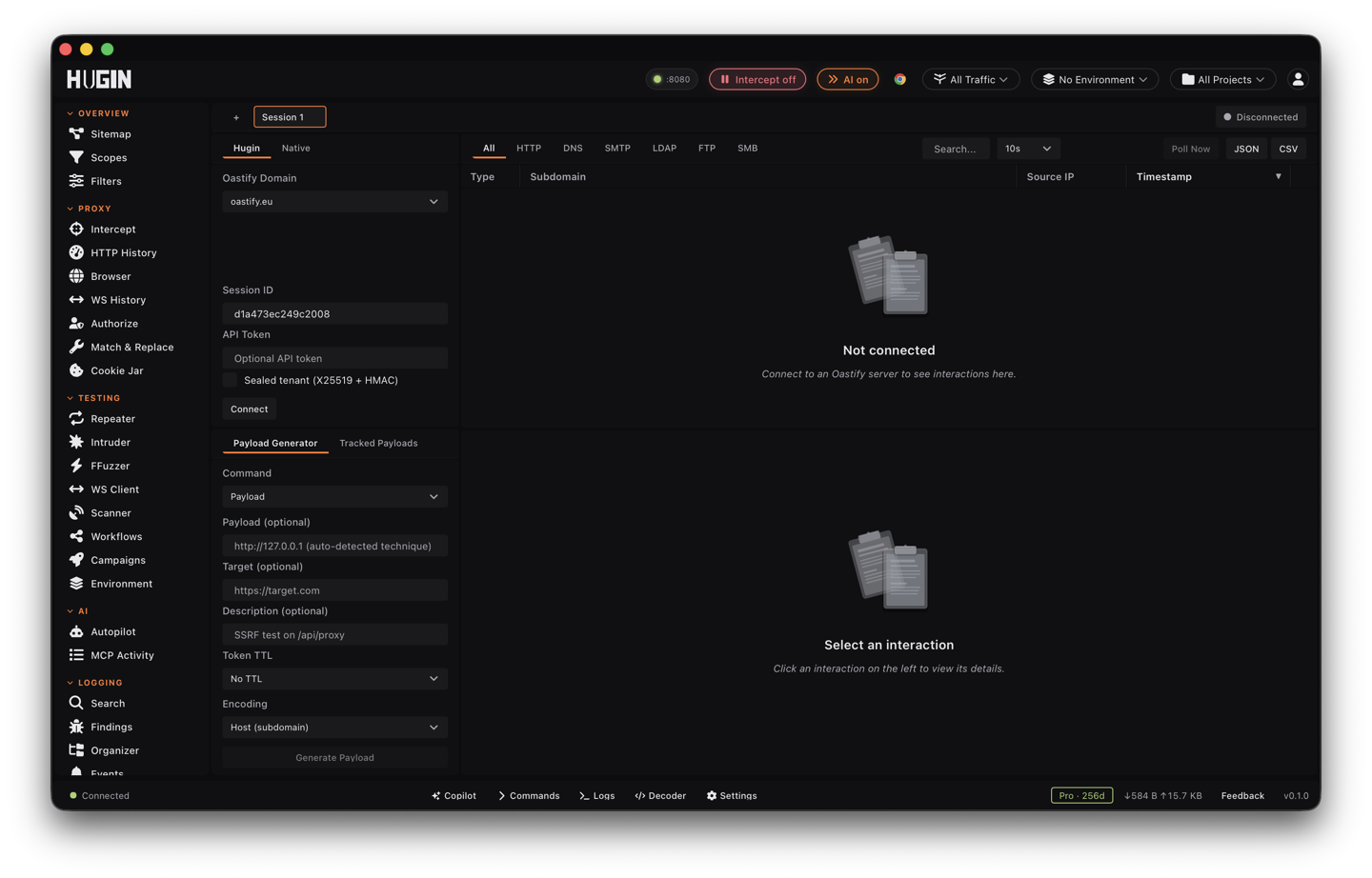
Oastify is Hugin's out-of-band (OOB) interaction server. It hands you a unique host carrying a correlation token and logs anything that touches it. When a target reaches out to that host — a DNS lookup, an HTTP fetch, an LDAP bind, an SMB connection — you have proof of a bug the response never showed you.
Which channel fires for which bug
The point of a listener per protocol is that bugs leak on different channels. DNS escapes networks that block everything else; LDAP is the Log4Shell path; SMB drags Windows credentials back. Reach for the channel the bug class actually uses:
The most reliable callback. A target with no outbound HTTP at all usually still
resolves a hostname. This is your channel for blind SQL injection (MSSQL
xp_dirtree, Oracle UTL_INADDR, MySQL LOAD_FILE over UNC), blind OS command
injection (nslookup, dig, ping your host), XXE parameter entities, and
SSRF where only the resolver leaks. A bare resolution proves reach.
When the target actually fetches your URL you get the whole request — method,
path, every header, body. This is SSRF that follows the redirect, XXE pulling a
SYSTEM URL, blind or stored XSS beaconing home, and SSTI that runs curl. The
headers often name the internal client (User-Agent, cloud metadata tokens).
The listener BER-parses the LDAP conversation, so a ${jndi:ldap://…} lands as
a real bind/search with its base DN and filter captured — not just an open
socket. This is the channel for Log4Shell, JNDI injection, and LDAP injection.
Drop a UNC path (\\host\share) into a path, link, or file field and Windows
authenticates to you. The standalone server captures the NetNTLMv2 handshake in
hashcat format — a callback that doubles as a crackable credential.
Real RFC 5321 verb handling: EHLO/HELO host, MAIL FROM, RCPT TO, and the subject on DATA. For email/SMTP header injection and SSRF aimed at a mail port.
Handles FTP commands and captures the username and verbs. For SSRF and XXE that
accept an ftp:// URL.
Pick the right payload shape
Each channel needs the payload in its own shape. generate mints one per
protocol against your domain — plant the one the sink expects:
| Channel | Payload to plant |
|---|---|
| DNS | {token}.oob.example.com |
| HTTP | http://{token}.oob.example.com/ |
| HTTPS | https://{token}.oob.example.com/ |
| LDAP (JNDI) | ldap://{token}.oob.example.com/dc={token} |
| SMTP | smtp://{token}@{token}.oob.example.com |
| FTP | ftp://{token}.oob.example.com/ |
| SMB (UNC) | \\{token}.oob.example.com\share |
HTTP and HTTPS also come in a path variant (http://oob.example.com/{token})
for sinks that won't take an arbitrary subdomain.
Correlation: every callback names one test
The {token} in each payload is a correlation id minted from the operating
system's CSPRNG (getrandom — not a userspace PRNG), so it is unguessable and
collision-free. Length is configurable (12–256 characters; alphanumeric, hex, or
base64), with an optional fixed prefix.
Every token is bound to the request and project that planted it, so an interaction maps back to the exact test — no guessing which payload of fifty fired. Interactions are logged live and optionally persisted; attach a context label when you generate to tag what you were testing.
More protocols, infrastructure you own
The in-app server runs all of the above — DNS, HTTP, HTTPS, SMTP, LDAP, FTP, and
SMB listeners, plus a raw-TCP catch-all. Running your own
standalone server adds RMI (:1099 for JNDI→RMI
gadget chains), gopher (SSRF protocol-smuggling), TFTP (UDP egress from
appliances), and a raw-TCP catch-all (JDBC, IIOP, anything custom) — and keeps
every callback on a box you control, encrypted at rest, with NTLM capture.
Let the Scanner confirm with it
The Scanner wires Oastify into its blind
checks — SSRF, XXE, blind SQLi, blind command injection,
Log4Shell, deserialization and more plant a correlated payload and poll for the
callback, so the finding arrives backed by a real interaction instead of a
guess. The Oastify view itself is a Pro feature: the server, the payload
generator, the interaction feed and the CLI all sit behind the Pro Oastify
feature. The one piece that needs no licence is the standalone
hugin-oastify-server binary you host yourself — see
self-hosting.